Selasa, 19 Juni 2012

Death by MVNHS© [UPDATED]

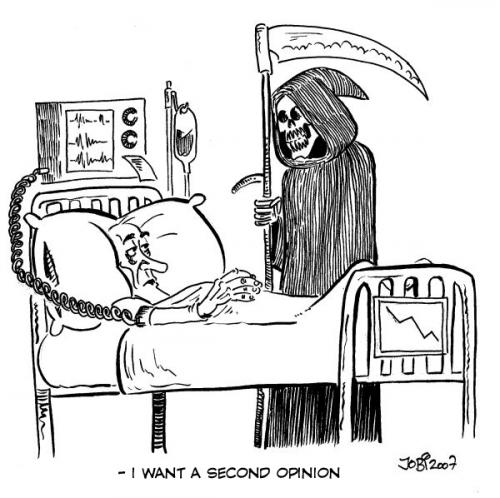
Last time we looked, the Much Vaunted National Health System© was busy killing off 78 year old bladder cancer patient Kenneth Ward. Lest Mr Ward feel left out, here's news that he's far from alone:


This is nothing new, of course: last year, we noted that "[h]ip replacements, cataract surgery and tonsil removal are among operations now being rationed in a bid to save the NHS money." Still, these new numbers show why a single-payer system can never really sustain itself. As Bob mentioned last week, "true single payer eliminates private industry. The government decides how much to pay the provider and what services are expected. The British NHS works like this" and the fact that 90% of British hospitals engage in health care rationing of this magnitude simply underscore his point.

Defenders of single payer like to point out that they're more cost effective than a free-market model. Of course, it's easy to be cost-effective when providers "are denying treatment despite guidance from the National Institute for Health and Clinical Excellence that patients should receive it."

Fewer Choices, Higher Costs: ObamneyCare©

Starting a new business is challenging enough, but navigating the maze of group insurance adds a whole new dimension. A frequent roadblock is the issue-and-participation requirement. This is a carrier rule based on the number of employees and how many opt for the group plan. Carriers justify this based on the concept of adverse selection (only sick people would sign up).

I recently met with the owners of a new company, and we quickly established that they'd be ineligible for a group plan based on participation requirements. Looking for alternatives, we wondered if a "stand-alone" Health Reimbursement Arrangement (HRA) would do the trick.

A stand-alone HRA is basically a health care debit card funded by the employer. A typical design might be $500 per year per employee; the first $500 of one's medical expenses would essentially be borne by the employer. Unlike a qualified Health Savings Account (HSA), there was no requirement for an underlying health insurance plan.

We thought this would be a great option in this case: it would mean that at least some of an employee's medical expenses could be shifted off his or her shoulders.

Alas, ObamneyCare© has ruled this out:

"Health care reform requires most group health plans to provide minimum annual levels of coverage for “essential health benefits”  ... In 2014 group health plans will have to provide unlimited annual benefits for “essential health benefits” ... The government has ruled that most HRAs are considered group health plans for these purposes."

In other words, stand-alone plans would themselves have to be "unlimited," a rather daunting prospect for any business. Needless to say, this plan was a no-go.

So of course we can see how ObamneyCare© has increased choices and lowered costs across the board.

Or not.

[Hat Tip: FoIB Alissa C]

Senin, 18 Juni 2012

ObamneyCare© SCOTUS Meter... [UPDATED]

For those waiting with bated breath for a decision on the ObamneyCare© case, take a deep breath and relax (for the nonce):


Um....

UPDATE: Something to ponder while we're waiting. FoIB (and Cato Institute Director of Health Policy) Michael Cannon shares his thoughts on the latest ObameyCare
© "bug:"

"Under the statute as written, if Congress fails to repeal IPAB [aka Death Panels] in 2017, then as of 2020 Congress will have absolutely zero ability to block or amend the laws that IPAB writes, and zero power to affect the Secretary’s implementation of those laws."

Michael, I'd observe that the folks behind this train wreck initiative would call that a feature, not a bug.

MVNHS© Customer Satisfaction takes a hit

As we've long noted, actual care delivery under the Much Vaunted National Health System© has been - at best - substandard. But don't just take our word for it:

"A new survey carried out by the King’s Fund health charity ... indicates that the general public’s levels of satisfaction with the running of the NHS have seen a marked drop. The number of people who were satisfied ... fell significantly to 58% in 2011."

Ooopsies.

MVNHS© leadership observed that these findings indicated that Brits are “worried and confused.” No kidding: they're worried because they see precisely how such systems fail to perform, and they're confused by the fact that it's still touted by the ruling class as terrific.

Regular readers already know that victims of participants in the MVNHS© can buy health insurance that can help pay for private care. The catch, which may be new to some, is that this service is available only to those on a waiting list.

Fortunately, this apparently comprises the majority of patients.

Out of Focus

Consumer Reports will begin evaluating and grading doctors, perhaps in much the same way as they do appliances and automobiles. According to the folks at Amednews, this pilot project will start in Gov. Romney's home state of Massachusetts, then eventually to other states.

Survey questions covered six general areas of the patient experience: communication; coordination of care; how well physicians get to know patients; the patient’s experience with office staff; whether the physician advised the patient on staying healthy; and pediatric care.

This is well and good but in most situations, the patient is ultimately responsible for their health. A patient that has a steady diet of cheeseburgers and Ding Dongs will never be healthy until they opt for a lifestyle change . . . something that is beyond the control of the physician.
“For me, what’s not addressed in this is the patient side of things,” he said. “Has the patient received the information and education they need, and are they doing what they were advised to do?”
A nation that is approaching a 50% obesity rate needs to invest in bathroom scales and a full length mirror. If your clothing size has an "X" on the label the problem is not your doctor.

"We have to change and we know that"


The Supreme Court decision on the Affordable Care Act is expected the week of June 25th, so the chatter is picking up again.   Kaiser Health News has an interesting article here that includes this comment:

“We have to change and we know that,” said Ken Raske, president and CEO of the Greater New York Hospital Association, which represents 250 hospitals and medical care facilities. “But it’s easier if you’re going to build the building to have the shovels and picks and the hammer and nails than trying to dig it out with your hands. That’s what the Affordable Health Care Act is.”

I think this suggests an attitude within the hospital industry that is worth thinking about.  Although Raske concedes hospitals have a business imperative to change, he warns they might have to slow down, unless government provides “shovels and picks and the hammer and nails”.  Since the Federales cannot supply these literal tools to the hospital industry I think it’s clear Raske is talking about money.  

The attitude is that, unless the government pays for change, change will be slow or nonexistent.  I just don’t accept that attitude.  Do you?

When other, non-hospital businesses have to change and they know it, what do they do?  Do they rely on their own resources?  Or do they rely first on getting government money - and tell their customers that they might not change – or might change slowly – if they don’t get it?  You know the answer.

Short version of the above - News flash:  the hospital industry says it must have more money from the government or it might slow down efforts to serve its patients better.

Health & Chocolate Down Under